

Publication date: 07/21/2025 – Updated: 12/17/2025
Recreational sea fishing in the Gulf of Lion Marine Nature Park
Stéphane sails regularly from our Port Adhoc Leucate. Every week, he takes his Cap Camarat off our dry stack and heads out for fishing trips in various zones, coastal waters near Port Leucate, offshore areas, and even the Leucate lagoon.
As an experienced angler, Stéphane has followed the recent regulatory changes closely. In 2024, the French Biodiversity Office (OFB), through the Gulf of Lion Marine Nature Park, introduced new obligations and restrictions.
The new Decree R93-2024-02-12-00002 aims to better regulate recreational sea fishing, ensuring it can continue without damaging marine resources.
Key changes to the recreational fishing regulations in the Gulf of Lion
Stéphane knows the Marine Park well: “In the Mediterranean, it spans 4,010 km², from Leucate in the north to Cerbère on the Spanish border in the south. It’s a protected marine area with many opportunities for both coastal and offshore navigation. Offshore, the park extends up to 35 nautical miles from the coast, where depths can reach 1,200 metres.”
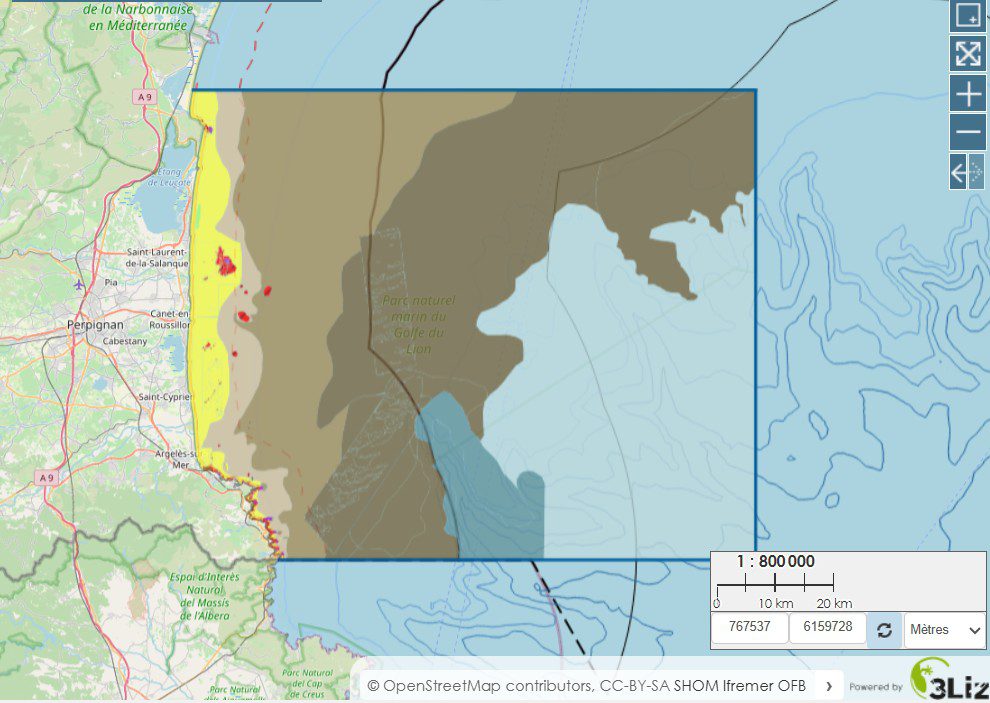
The experienced boater explains that with the Decree on specific regulations for recreational sea fishing within the Gulf of Lion Marine Nature Park, there have been three major changes:
- The introduction or modification of fishing quotas, by species, per angler, and per boat
- The revision of minimum size requirements for fish and cephalopods (also known as “mesh size”)
- A mandatory fishing permit, to be renewed annually, has been introduced for all recreational boaters wishing to practise leisure fishing within the boundaries of the Park.
Stricter catch quotas
Species-specific quotas
The revised regulations primarily concern the number of authorised catches per species.
According to the French Office for Biodiversity (Office français de la biodiversité), these quotas aim to “limit the capture of the most vulnerable species, the most heavily fished species and the most emblematic species”.
| Fish in the Gulf of Lion Marine Nature Park | Quota per angler |
|---|---|
| Barracuda/Yellowmouth barracuda | 3 fish |
| Atlantic bonito | 5 fish |
| Red scorpionfish | 2 fish |
| Horse mackerel | 10 fish |
| Conger eel | 3 fish |
| Dentex | 1 fish |
| Common dolphinfish | 3 fish |
| Gilthead seabream | 3 fish |
| Ornate wrasse | 10 fish |
| Brown wrasse | 3 fish |
| Leerfish (garrick) | 2 fish |
| Greater amberjack | 5 fish |
| Little amberjack | 5 fish |
| European seabass | 2 fish |
| Mackerel (Atlantic and Spanish) | 10 fish |
| Forkbeard | 3 fish |
| Saddled seabream | 10 fish |
| Axillary seabream | 10 fish |
| Common pandora | 5 fish |
| Red pandora | 3 fish |
| Red mullet/Rock mullet | 10 fish |
| Sharp-snout seabream | 10 fish |
| Zebra seabream | 10 fish |
| White seabream | 10 fish |
| Common two-banded seabream | 1 fish |
| Salema | 10 fish |
| Comber | 10 fish |
| Painted comber | 2 fish |
Daily catch quota per angler
In addition to per-species limits, recreational anglers must also comply with a daily catch limit: a maximum of 10 catches per person per day, combining fish and cephalopods.

A catch quota per boat
Another key rule to note concerns the daily quota per vessel, set at a maximum of 30 catches per boat, regardless of the number of people on board.
➡️ For example, if 6 people go on a one-day fishing trip in the Gulf of Lion Marine Nature Park, the total quota for all passengers is 30 fish. Shared equally, this results in a limit of 5 fish per fisher, instead of 10.
Fishing bans and closed seasons
Recreational fishing in the Gulf of Lion Marine Nature Park is prohibited for three specific species: grouper, corb, and green wrasse.
Biological rest periods have also been introduced to protect the breeding cycles of certain species:
Common dentex: fishing prohibited from 1 May to 30 June
Seabass: fishing prohibited from 1 January to 31 March
- Common seabream (red porgy): fishing prohibited from 1 March to 31 April
- Brown meagre: fishing prohibited from 1 May to 30 June
- Octopus: fishing prohibited from 1 June to 30 September
Increased minimum size requirements for fish
“The legal minimum sizes for fish have really changed,” says Stéphane. “There are now new minimum size limits for nearly all fish species.”
Fish size regulations in the Gulf of Lion Marine Nature Park
| Fish in the Gulf of Lion Marine Nature Park | Minimum size |
|---|---|
| Barracuda/Yellowmouth barracuda | 65 cm |
| Atlantic bonito | 40 cm |
| Red scorpionfish | 35 cm |
| Horse mackerel | 20 cm |
| Conger eel | 120 cm |
| Dentex | 40 cm |
| Common dolphinfish | 60 cm |
| Gilthead seabream | 30 cm |
| Ornate wrasse | 15 cm |
| Brown wrasse | 25 cm |
| Leerfish (garrick) | 50 cm |
| Little amberjack | 25 cm |
| European seabass | 42 cm |
| Mackerel (Atlantic and Spanish) | 25 cm |
| Forkbeard | 30 cm |
| Saddled seabream | 20 cm |
| Axillary seabream | 25 cm |
| Common pandora | 25 cm |
| Red porgy | 30 cm |
| Red mullet/Rock mullet | 20 cm |
| Sharp-snout seabream | 25 cm |
| Zebra seabream | 25 cm |
| White seabream | 25 cm |
| Common two-banded seabream | 40 cm |
| Salema | 25 cm |
| Greater amberjack | 65 cm |
| Comber | 15 cm |
| Painted comber | 20 cm |
Fish must be measured from the tip of the snout to the end of the fully extended caudal fin. If the specimen does not reach the minimum legal size, it must be returned to the water. Stéphane also reminds boaters that caught fish must always be marked by cutting the caudal fin of the species concerned.
For octopus, the regulation specifies a minimum weight of 1 kg, rather than a minimum size.

A mandatory fishing permit in the Gulf of Lion marine natural park
Since 12 February 2024, all recreational fishers wishing to fish within the boundaries of the Gulf of Lion Marine Natural Park must hold a fishing permit.
This requirement applies to:
- Sea fishing
- Shore fishing
- Anyone aged 12 and over.
The permit is issued free of charge via the CatchMachine app (available on iOS and Android) or directly at the offices of the Marine Natural Park in Argelès-sur-Mer.
It is valid until 31 December of the current year and must therefore be renewed annually.
Each fisher must ensure that they:
- have obtained the permit before their first outing
- are able to present it during inspections, either in digital or paper format.
Any breach of the regulations set out in this decree constitutes an offence punishable by a fine of up to €22,500.
What will change from 2026: a strengthened national framework
In addition to the local regulations of the Gulf of Lion Marine Natural Park, a new national decree dated 7 November 2025, published in the Official Journal, provides broader regulation of recreational sea fishing across France.
From 10 January 2026, new national obligations will come into force. These will not replace the Park’s specific rules but will apply in addition to them.
They include in particular:
- Mandatory electronic registration for recreational fishers aged 16 and over, regardless of the targeted species (excluding shore fishing)
- Mandatory catch reporting for certain sensitive species, under conditions defined at national level
These measures aim to improve monitoring of catches and promote sustainable management of fishery resources, including in the Mediterranean.
Recreational fishing regulations in the Gulf of Lion: our team is here to help
Do you own a boat moored at Port Adhoc Leucate and wish to go recreational fishing in compliance with the new rules? We invite you to visit our team at the harbour office: we offer summary adhesive measuring guides listing all the new requirements – handy tools to use on all your fishing trips!
As the implementation details of the national obligations may evolve, fishers are strongly encouraged to consult official sources on a regular basis.


