

Publication date: 04/06/2026
Many sailors are unsure:
What is legally required — and what is merely recommended? Do the same rules apply on inland waters as at sea? What equipment is subject to inspection? And what about offshore passages, such as heading towards the Atlantic?
This article provides a clear, practical overview so you know what is truly mandatory and what is strongly recommended for safe, worry-free sailing.
Why safety regulations in sailing are essential
At first glance, safety regulations can seem like dry bureaucratic box-ticking. In practice, however, they are the result of decades of experience — and, unfortunately, many accidents.
A burst hose. Engine failure in an onshore wind. A crew member overboard. In moments like these, everything can be at stake, and every piece of equipment counts.
That is precisely why it pays to view legal requirements not as a minimum, but as the foundation for responsible sailing — whether you’re sailing alone, with friends, or with your family.
In Germany, several regulatory layers work together:
Maritime and Inland Waterways Traffic Regulations (SeeSchStrO / BinSchStrO)
The Maritime and Inland Waterways Traffic Regulations (SeeSchStrO / BinSchStrO) form the central legal framework for traffic on Germany’s sea and inland waterways. They govern right of way, lights, sound signals, collision avoidance, speed limits, and — in specific cases — safety requirements for vessels and skippers.
The SeeSchStrO applies to German sea shipping lanes (e.g. coastal waters, estuaries, maritime areas), whilst the BinSchStrO covers rivers, canals, and lakes on federal inland waterways.
👉 For sailors, this means: these regulations define how to conduct yourself in traffic, what equipment must be operational, and what responsibilities the skipper bears. They are not merely rules on paper — they are the binding foundation for safe, orderly, and legally compliant sailing in Germany.
Occupational Safety Rules & DIN Standards
Occupational safety rules and DIN standards complement legal requirements with concrete, practice-based safety standards. Occupational health and safety associations — in particular the Berufsgenossenschaft Verkehr — develop accident prevention regulations and safety rules that, whilst primarily aimed at the commercial sector, can also serve as a benchmark for safe equipment and procedures in recreational sailing.
DIN standards, published by the German Institute for Standardisation, set minimum technical requirements — for example for life jackets, life rafts, lines, fire extinguishers, and safety markings.
👉 Important for sailors: these rules are generally not directly mandatory by law, but are referenced by insurers, surveyors, courts, and charter companies to assess whether a vessel was equipped “to the current state of the art.” Adhering to them therefore puts you on solid ground — both legally and practically.
Recommendations from the DSV, Water Police & Sea Rescue
The recommendations from associations, authorities, and rescue organisations deliberately go beyond the legal minimum and are grounded in real accident scenarios.
The German Sailing Association (Deutsche Segler-Verband) publishes practical guidelines on safety equipment, crew training, and responsible behaviour on board, aimed particularly at cruising sailors and families.
The Water Police (Wasserschutzpolizei) regularly issues safety advisories on common causes of accidents, equipment deficiencies, and unsafe behaviour — recommending, amongst other things, the consistent wearing of life jackets, even when not always required by law.
The sea rescuers of the German Maritime Search and Rescue Service (DGzRS) base their recommendations directly on operational experience and strongly advise carrying additional emergency equipment such as AIS-MOB devices, safety tethers, waterproof communication devices, and thorough crew preparation.
👉 For sailors: these recommendations are not legally binding, but they represent best practice and can make the critical difference in an emergency.
Further detailed information on sailing safety can be found on the websites of the Federal Waterways and Shipping Administration (WSV), the Federal Ministry for Digital and Transport (BMDV), and ADAC Skipper.
Important:
👉 Not everything that makes sense is legally required.
👉 Not everything that is required is sufficient in practice.
This often causes confusion — but it can be resolved step by step.
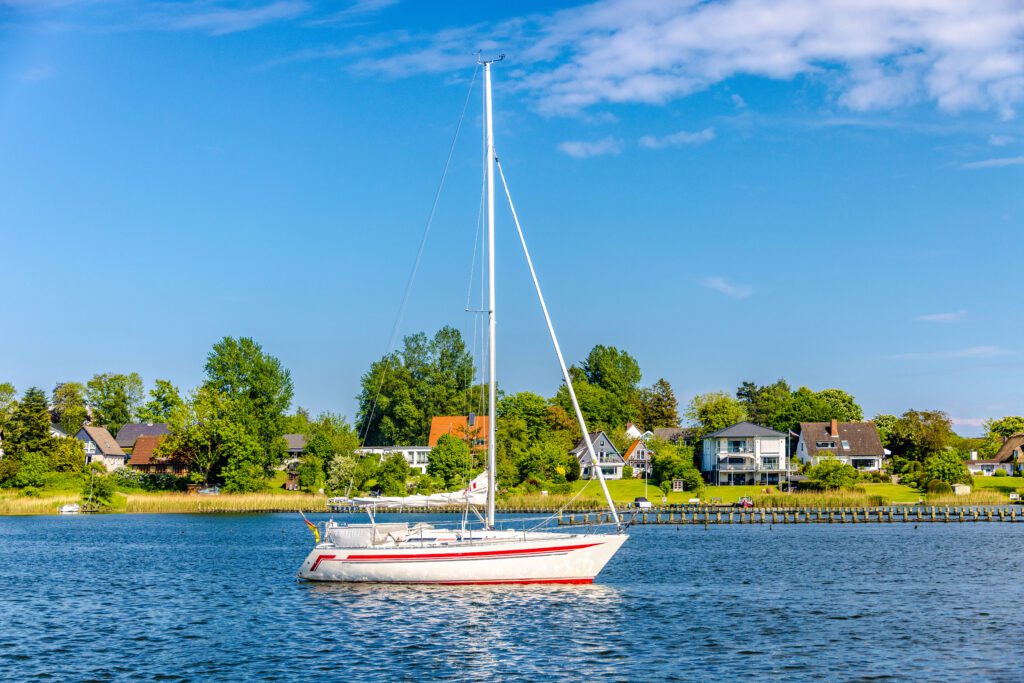
Which safety equipment is mandatory for Sailing in Germany, and what is strongly recommended?
This is one of the most frequently asked questions. The answer is that there is no nationally uniform “mandatory equipment list” as exists, for example, for road vehicles.
Requirements also vary by sailing area in terms of what is standard, advisable, and common practice. The legal framework is based on the SeeSchStrO / BinSchStrO, the Collision Regulations (COLREGs), and the skipper’s general duty of care.
Many items fall under the standard of good seamanship, or are insurance and charter requirements, or strong recommendations from the DSV/DGzRS.
➡️ Please note: this article does not constitute legal advice. Binding obligations may differ depending on the sailing area, vessel type, intended use (private/commercial/charter), and any conditions attached to the vessel’s certificate. The applicable local regulations and instructions are authoritative.
Equipment considered the generally recommended basic standard
The following are considered the general good seamanship standard across all sailing areas:
- Life-saving equipment for all persons on board
- At least one life jacket per person readily available
- A buoyant rescue device (e.g. lifebuoy or horseshoe buoy)
- Anchor with sufficient chain/line
- Sound signalling device (e.g. horn or whistle)
- Navigation lights (at night or in poor visibility)
- Fire extinguisher (if the vessel is motorised
👉 Important: equipment should be ready for use, accessible, and in working order.
Equipment for sailing boats on inland waters in Germany
On inland waters such as lakes, rivers, and canals, requirements differ somewhat from those at sea.
What is standard on inland waters:
- Life jacket available for every person on board
- Lifebuoy or equivalent rescue device
- Anchor with line/chain
- Sound signalling device
- Lighting as required by regulations
- Fire extinguisher (for engines above a certain power output)
What is recommended:
- First aid kit (waterproof)
- Paddle or boat hook
- Spare line
- Mobile phone in a waterproof case
- Torch
Safety is often underestimated on inland waters. Yet a disproportionate number of accidents occur here — frequently caused by collisions, strong winds, or technical failures.
Safety equipment at sea
As soon as you venture into coastal waters or the open sea, requirements increase. Under the law, the skipper must be capable of calling for help and rendering assistance in emergencies.
Recommended:
- Life jackets available for all persons on board
- Lifebuoy with line
- Signalling devices
- Daytime: visual signals (e.g. signal flag)
- Night-time: light signals
- Navigation lights
- Anchor
- Fire extinguisher
- Marine radio or alternative emergency communication device (depending on the sailing area)
These points represent a practice-oriented baseline. Depending on the vessel, sailing area, weather conditions, crew, and intended use, significantly more may be sensible or required (e.g. under charter or insurance conditions).
For offshore sailing (such as on the Atlantic), international recommendations, insurance requirements, charter and flag state regulations apply — and above all: common sense.
Strongly recommended for offshore sailing:
- Life raft (for all persons on board)
- EPIRB or PLB
- AIS-MOB system
- Auto-inflate life jackets with safety tethers
- Fixed jacklines
- Comprehensive emergency and first aid equipment
- Redundant navigation (GPS + paper charts)
- Storm sail or trysail
- VHF radio with DSC
Many insurers make this equipment a mandatory requirement, even if it is not explicitly required by law. It is therefore advisable to check your insurer’s specific conditions carefully.
Safety for families and crews goes beyond regulations
Especially when children or less experienced crew members are on board, safety standards should be set one level higher.
The following practical recommendations have proved their worth:
👉 Auto-inflate life jackets should be worn at all times, and child-specific life jackets should be used for younger children.
👉 Additional safety measures include lifeline netting and non-slip deck surfaces, as well as clear on-board rules (e.g. no going on deck alone) — rules that are actually followed.
Safety does not begin with equipment. It begins with sensible behaviour.

Inspections & consequences: what happens in case of violations?
The Water Police and harbour authorities conduct regular inspections on German inland and coastal waters — not only at random, but also in response to specific triggers such as reported incidents, accidents, or periods of high traffic.
If an inspection reveals that required safety equipment is missing, incomplete, or not in working order, the consequences can be significant. These range from fines and temporary bans from sailing to the immobilisation of the vessel if safe continuation of the voyage cannot be guaranteed.
In the event of a claim, missing or non-operational equipment — depending on the policy and circumstances — can cause complications with insurance payouts (e.g. if policy obligations were breached or gross negligence is a factor).
The legal dimension is even more serious: inadequate safety equipment can, in an emergency, give rise to personal liability for the skipper — particularly if people are injured. Safety is therefore not only a matter of responsibility, but also of legal self-protection.
➡️ Please note: for commercially operated vessels, charter yachts, training vessels, or rented pleasure craft, significantly stricter and more specifically regulated equipment requirements apply compared to privately used boats.
Conclusion: safety is not a limitation — it is your backbone when sailing
Safety regulations for sailing in Germany are not an end in themselves. They are the foundation that allows you to glide freely, confidently, and safely across the waves.
Whether you’re sailing on inland waters, planning coastal passages, or dreaming of offshore adventures: those who know their equipment, maintain it, and supplement it wisely sail more calmly, more confidently, and with greater peace of mind.
If you plan to use your boat long-term — whether in summer, in winter storage, or as a year-round berth — a well-thought-out safety set-up always pays off.
Would you like to keep reading and discover the best sailing destinations in Germany?


